Process mapping and automation planning
Map repeated admin before deciding what to automate.
Choose the first safe automation from a clear process map, human decision points and an agreed phase plan.
Email us about your next stepProcess mapping and automation planning
Choose the first safe automation from a clear process map, human decision points and an agreed phase plan.
Email us about your next stepCopying information, checking shared inboxes, preparing standard updates and chasing approvals can consume attention in small increments. We map the actual sequence rather than relying on how the process is supposed to work. That includes exceptions, rework and the moments when somebody uses judgement. The aim is to understand the operation before proposing software. A clear map often reveals that a form, responsibility change or simpler rule should come before any automation.
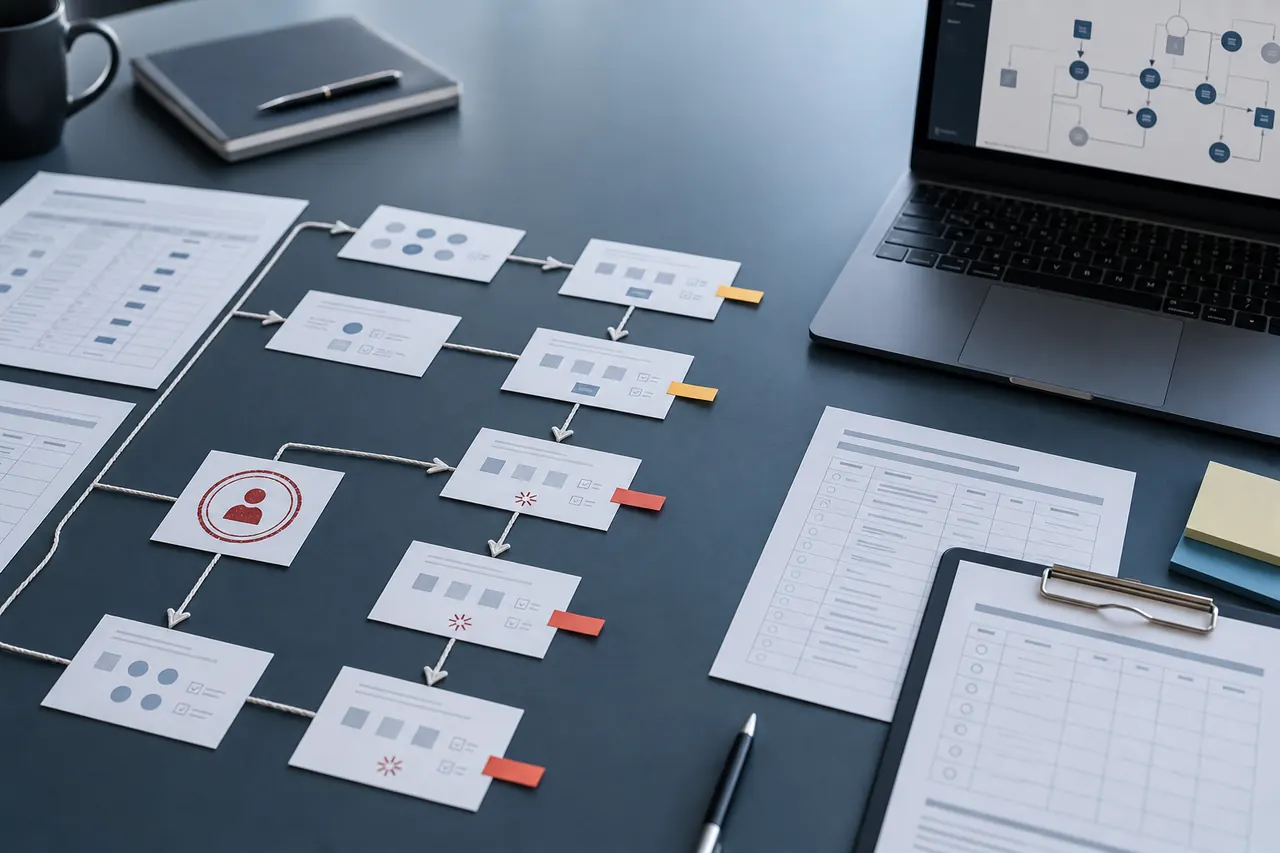
The schematic shows a request entering, being checked, assigned, completed and recorded, with a person making the important approval. It is visibly labelled as an illustrative example and contains no customer information or claimed result. The map demonstrates how triggers, actions, decisions and records are distinguished. A real mapping session uses the team's words, current systems and genuine exceptions so that a future build does not silently automate an idealised process that nobody follows.
Inputs include forms, messages or files that start the work. Ownership identifies who is responsible at each hand-off. Decisions show where policy or judgement changes the route. Exceptions record unusual cases and safe fallbacks. Evidence describes what should be stored so the team can understand what happened later. Together these elements create a practical automation brief. They also expose missing rules that need a business decision before a reliable build can begin.
Reliable starting points are often deterministic tasks: copying approved fields, creating a record, sending a standard acknowledgement or reminding an owner. Pricing decisions, sensitive customer responses, unusual cases and final approvals may need to remain human. The boundary depends on consequence, not fashion. We label the split explicitly so staff know what the system may do and when work must stop for a person. Clear fallback behaviour matters as much as the happy path.
Map it means confirming the real process and its exceptions. Build the first step means implementing only the agreed narrow action. Test with you means using controlled examples and checking the record produced. Watch and adjust means reviewing early operation and correcting assumptions before expansion. These phases set expectations without pretending every process takes the same duration. Progress is based on agreed evidence and safe behaviour, not decorative bars or arbitrary percentages.
The package includes a current-state map, problem statement, ownership notes, safe-versus-human boundary, information considerations and a phased first-build plan. Potential tools are considered against existing systems and operational needs rather than selected in advance. The output remains useful if another supplier builds it. No return figure is invented; the business decides whether removing the identified friction justifies the effort after seeing the scope, risks and expected operational change.
You receive a readable process diagram, exception list, responsibility table, data field notes, acceptance checks and a first-step brief. Each item identifies assumptions for the owner to confirm. The materials prevent a builder from guessing how the work should behave and give staff a shared reference when the process changes. If the mapping shows that automation is not suitable, that is a useful outcome: the team can improve the manual process without adding a fragile system.
After mapping, we choose a first action with a clear trigger and low consequence of failure. Access is arranged through appropriate controls after agreement; credentials are not sent by ordinary email. Controlled examples test normal and exceptional paths. The owner signs off before live use. Early operation is watched, failures are made visible and documentation is updated. Expansion only follows evidence that the first step behaves as intended and remains understandable to the people responsible.
Not every repeated task deserves automation. Low volume, high variation or unclear ownership may make manual improvement more sensible. A process map can still be valuable because it exposes decisions and hand-offs. Existing applications may be sufficient; the plan does not require a new platform by default. Human review remains where consequences demand it. Security, privacy and supplier terms need proportionate consideration before real business information is connected.
Tell us what triggers the work, who handles it, which applications are involved and where it tends to stall. Do not send credentials, customer records or confidential files in the first message. We will reply with the mapping questions and whether the process looks suitable for a bounded planning exercise. The first conversation is about understanding the work accurately, not rushing into a build before ownership, exceptions and safe stopping points are clear.